How to check if your dice are balanced

Ever felt like your rolls are cursed? Maybe it's not your luck - maybe it's your dice. Unbalanced dice can ruin fair gameplay and skew outcomes in critical moments. In this guide, we'll show you how to test dice balance using easy at-home methods like the saltwater dice test, explain what makes dice unfair, and help you find dice you can trust.
Are D&D dice fair?
Yes. D&D dice are, generally speaking, balanced. Each die in a standard set (d4, d6, d8, d10, d%, d12, and d20) uses an isohedral design. In simple terms, this means they are symmetrical on all sides, so they should roll fairly.
As long as you’re buying from a reputable retailer, you shouldn’t have any issues. That said, there are a few factors that might make you unsure about how balanced your dice are, or you may simply want to test them out of curiosity or for fun. There are several ways you can check whether your dice are balanced.
Dice Balance Test Methods
1. Dice Saltwater Test
The saltwater dice test is the most popular DIY method for checking whether a die is weighted or unbalanced.
A properly balanced die has its weight evenly distributed, so when it floats freely, no single face should consistently rise to the top. A weighted die, on the other hand, is heavier on one side, causing the lighter side to float upward repeatedly. When this happens, the saltwater test can help reveal the imbalance.
It’s a quick, simple way to check if dice are balanced.
What You Need:
- Table salt
- A clear glass or bowl
- Warm water
- The die in question
- A spoon for stirring
- Something to record the result in (like our dragon notebook!)

Above: A photo of us carrying out the saltwater balance test on one of our plastic dice sets.
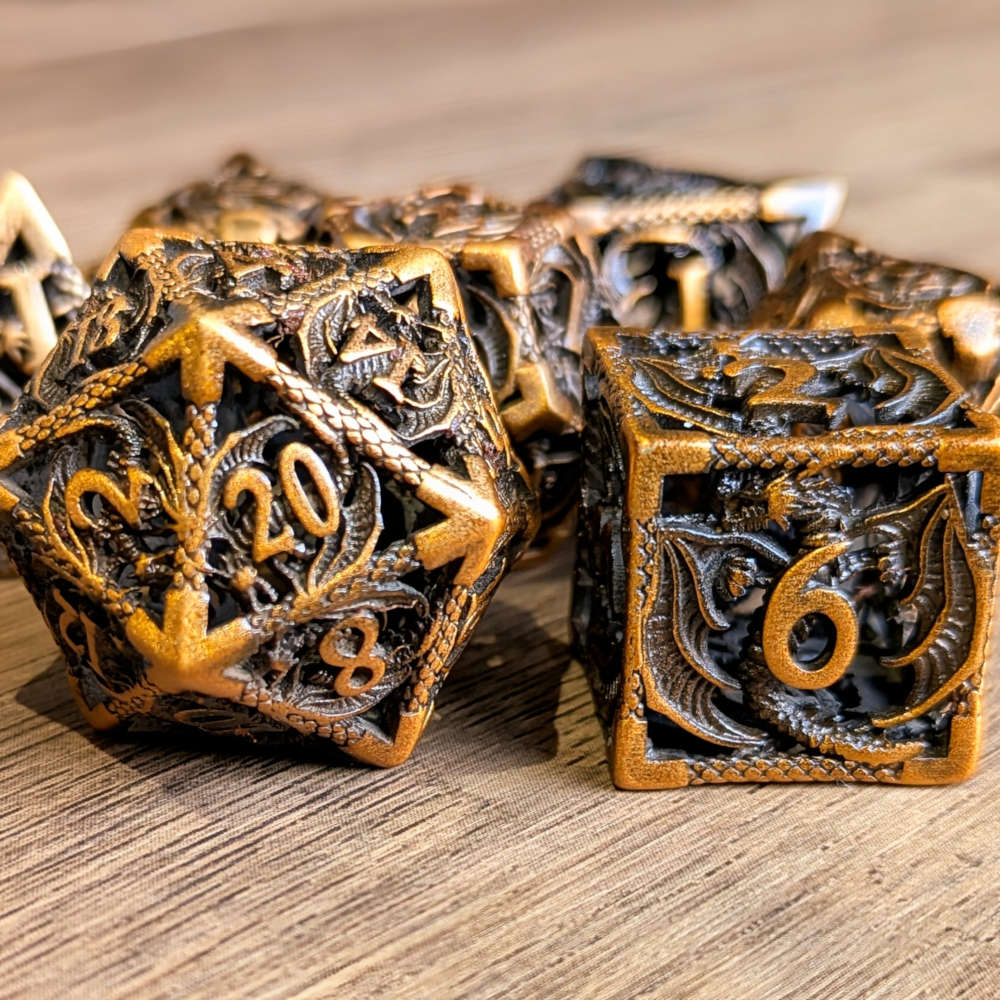
Don’t use the saltwater test with metal dice, as the water can damage them or cause rust if they aren’t dried thoroughly. In many cases, the test won’t work anyway, since metal dice are often too heavy to float, depending on the container.
How to Perform the Saltwater Test:
- Fill your glass or bowl with warm water (warm dissolves salt better).
- Add salt slowly, stirring until the die just barely floats.
- Gently spin or nudge the die, then let it settle.
- Let it settle and note which face lands upward.
- Repeat 20+ times.
Results: If the same number comes up disproportionately, your die may be biased.
Although the saltwater dice test is helpful, it isn’t a fully accurate or scientific way to determine test if dice are balanced. Casinos, for example, rely on precision manufacturing and techniques such as statistical roll analysis. That said, for home games like D&D, the saltwater test is more than sufficient.
Shop our range of balanced sharp-edge dice sets now.
2. Roll Distribution Test
Roll your die 100+ times, record each result, and compare frequencies.
Steps:
- Roll the die on a flat surface 100 times.
- Tally how often each face appears.
- Analyse results: in a fair d20, each face should show ~5 times.
Tip: Use a dice rolling tray to ensure you have a flat and safe surface.
You can use the following table to record your dice rolls. Using this table, you can test whether your dice are balanced, using any die from a D&D dice set - from a d4 up to a d20.

This is the most reliable way to test dice for randomness, but it can be quite time-consuming. As with the saltwater dice test, you need a large number of rolls before you can draw clear conclusions about whether your dice are balanced, which can take a significant amount of time.
3. Visual Inspection
Sometimes unfair dice show physical signs of flaws. A visual check can’t prove a die is fair, but it’s a good way to spot red flags and decide whether it’s worth properly testing the balance.
Some visual checks you can do include:
- Check symmetry and shape: A fair die should be symmetrical. In simple terms, look for even edges and corners, consistent faces, and even rounding if the die is rounded.
- Inspect the pips or numbers: Whether the die uses pips (dots) or numbers, check how the paint has been applied. Look for excess or missing paint, uneven filling, or signs that some numbers are deeper or wider than others. Paint pooling on certain faces is also a red flag.
- Look through the die: This is especially important for clear or translucent dice. Hold the die up to a bright light and slowly rotate it. Look for air bubbles or empty spaces. If the die has inclusions, check whether they are centred or drift towards one side.
If you go through these checks and something feels off, you’re unsure, or you spot any red flags, that’s a good sign you should test the dice balance more closely.
What is a fair die?
A fair die is one that isn’t biased, loaded, or weighted. Fair dice have an equal chance of landing on each side, meaning every result is just as likely.
For example, a twenty-sided die (d20) is considered fair when each face has a 1 in 20 chance, or 5%.
FAQ: Dice Balance Explained
What is a balanced die?
A balanced die has an equal chance of landing on any of its faces. No side is heavier or more likely to appear.
How do I check if dice are balanced?
Try the saltwater test, roll test, or inspect them visually. Ideally, use multiple methods to confirm dice balance.
Why are some dice unbalanced?
Imperfect molds, bubbles, material density issues, or paint inconsistencies can throw off balance.
Is the saltwater test reliable?
It’s good for spotting major bias but can’t detect subtle imbalance. Combine it with a roll test for better accuracy.
Are resin dice balanced?
In general, yes - resin dice are balanced. If you buy from a reputable retailer, or carefully inspect handmade dice for flaws or air bubbles, you’re unlikely to run into any issues.
Dice with inclusions, like our cheeky Duck Dice Set, raise a common question: do those inclusions affect balance? The short answer is yes, they can introduce a slight imbalance. In a casino setting, that would be a problem, as the dice wouldn’t be perfectly fair. For practical use in a D&D game, however, they’re balanced enough to make no real difference.
The inclusions are very light, and any imbalance is so minimal that it would only become noticeable over an enormous number of rolls - think tens of thousands. In normal play, you’d never spot it. So, in short: yes, resin dice are balanced.
Are metal dice better balanced?
Yes, metal dice are generally better balanced than plastic dice. This is because they are usually made from a single, solid piece of metal, which means there are few or no air bubbles or density issues inside the die. Their even density makes them more reliable for fair rolls.
Read more about the differences between plastic and metal dice in our guide.
How many rolls are needed to test dice?
At least 100. The more you roll, the more reliable the data.
How do I tell if a dice is loaded?
Loaded dice are designed to land on certain numbers more often. Float tests and rolling patterns can help detect them.
What should I do with unbalanced dice?
If you have any defective dice that are unbalanced in a random way, keep them for casual or decorative use, but don’t use them for serious games. Loaded or weighted dice can have valid uses in D&D, such as for creative mechanics, but make sure this is agreed in advance with everyone at the table.
Explore our range of dice
Now that you’ve learned how to check your dice balance, why not explore more about the world of dice? Take a look at our guide to the most popular dice colours and discover what makes each one stand out.
And if you’re still feeling unlucky, even with balanced dice, maybe it’s time for a new set! Treat yourself to one of our TTRPG dice sets, available in a range of styles and materials. If you like bold and eye-catching designs, try our red dice. Or, if you prefer something calmer, our blue dice sets might be more your style.